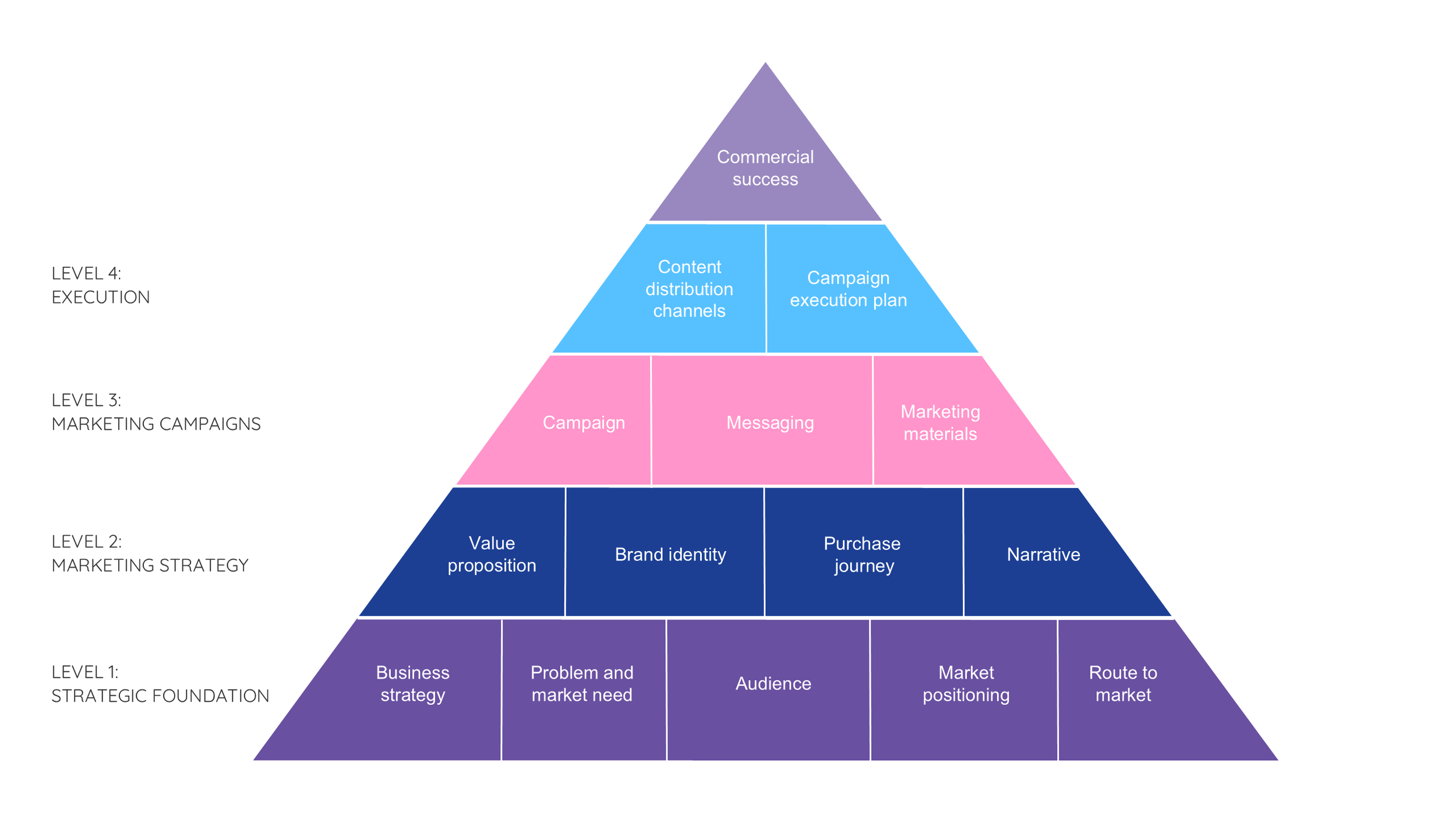
Level 1: Strategic foundation
Clear strategy is the anchor governing all commercial success.
Business strategy
None/Basic: No documented business strategy exists. There is no structured approach to addressing the company's most important competitive, regulatory, or technical challenges.
Moderate: Leadership has a strategy in mind, or it exists in a high-level presentation. However, it lacks clear priorities, resource allocation, and defined choices about where to focus or compete.
Advanced: A documented business strategy clearly explains how the company will address its most important industry challenge. This includes explicit decisions about markets or opportunities the company will and will not pursue, and a clear explanation of the company's competitive advantage.
Problem and market need
None/Basic: The problem being solved is unclear, generic or poorly defined. Marketing focuses on product features rather than customer needs.
Moderate: A market need has been identified, but the problem statement is too broad or lacks urgency. Or the solution is not compelling enough to drive strong customer adoption.
Advanced: The problem the company solves is clearly defined and immediately relevant to customers. There is evidence that customers are willing to switch and pay for the solution.
Audience
None/Basic: The target audience is defined too broadly (for example, "all biotech companies"). There is little understanding of the specific "jobs" customers are trying to get done, nor the struggles they encounter.
Moderate: Audiences are segmented by personas or broad job functions (e.g. lab managers). The specific outcomes that they are trying to achieve, their current workarounds, and the specific barriers they face are unmapped.
Advanced: Customer pain points are clearly defined. Audiences are segmented by "Jobs-to-be-Done" and validated through research. Messaging is tailored to specific scientific, technical, or operational buyers.
Market positioning
None/Basic: Positioning is unclear, generic, or closely resembles competitors. The company is difficult to distinguish from other providers.
Moderate: Leadership has a shared understanding of the company's positioning. However, it has not been formally documented or communicated externally.
Advanced: A documented positioning statement clearly defines what the company wants to be known for and how it differs from competitors e.g. "We are the LC-MS host cell analysis company for complex biologics."
Route to market
None/Basic: The sales approach and commercial model are undefined or based on assumptions. Pricing lacks an understanding of internal costs or customer willingness to pay.
Moderate: A sales model and route to market have been selected (for example, direct sales or distributors). But the approach is not documented in a playbook. Pricing strategy exists but willingness to pay has not been validated through customers.
Advanced: A documented Commercialisation plan clearly defines how the company will reach customers. The plan identifies the sales channels, why they were chosen, and includes a timeline and resource plan for expanding commercial activity.
Level 2: Marketing strategy
Translating core value into customer-ready communication.
Value proposition
None/Basic: No value proposition exists that clearly explains how the company’s product or service uniquely solves a specific customer problem.
Moderate: A value proposition has been written, but it is overly technical and does not clearly communicate unique customer value.
Advanced: A clear, evidence-based value proposition is documented. It explains who the target audience is, their most important challenge, why existing solutions are inadequate, what the ideal solution looks like, and what outcomes can be achieved.
Brand identity
None/Basic: The company has no documented brand identity. Visual branding, tone of voice, and market presence are inconsistent or poorly defined. The company appears similar to competitors and lacks a distinct market identity.
Moderate: The company has defined some brand elements, such as a logo, and visual guidelines (colours, fonts, typeface etc.). Branding is generally consistent across channels but does not clearly associate the company with a specific area of expertise or differentiate it from competitors.
Advanced: Documented brand guidelines clearly define what the company stands for, who it serves, and how it differs from competitors. The brand is consistently applied across customer touchpoints, creating a distinctive and recognisable market presence associated with a clear area of expertise.
Purchase journey
None/Basic: The customer journey is not mapped. It is unclear how prospects discover, engage with, and decide to buy from the company.
Moderate: The general buying process is understood. However, there is limited visibility into how customers engage, which channels they prefer, or where prospects are lost in the process.
Advanced: The customer journey is fully mapped from awareness to purchase. Data is available on conversion rates and performance at each stage.
Narrative
None/Basic: No company narrative exists. External communication focuses heavily on product features, technical specifications, or reactive messaging.
Moderate: A company story has been drafted, but it reads more like a standard corporate history or an extended mission statement. It is not used consistently to frame market conversations or drive content.
Advanced: A documented, compelling market narrative is established. It clearly articulates a major shift or macro-trend in the industry, explains why the old way of working is no longer viable, and positions the company's category or approach as the inevitable future approach.
Level 3: Marketing campaigns
Developing original, focused initiatives that drive urgency.
Campaign
None/Basic: Campaigns are a set of tactics that lack originality and do not address customers' most important challenges.
Moderate: Campaigns focus on relevant problems but are predictable and fail to stand out from competitors.
Advanced: Campaigns use creative, distinctive approaches that address a critical industry challenge. They clearly differentiate both the product and the brand.
Messaging
None/Basic: Vague or product-led, with no clear link to the campaign objective (e.g. awareness or urgency). The problem is weakly defined, so the campaign messaging lacks a compelling reason for the audience to care or act.
Moderate: Aligned to the campaign objective and addresses a relevant problem but remains generic. It informs rather than persuades, lacking distinctiveness or urgency to drive action.
Advanced: Clearly tied to an objective. It frames the problem compellingly, tells the audience why they should care and presents the solution uses distinctive language to drive action.
Marketing materials
None/Basic: Content is limited and not aligned with customer needs. Marketing materials are generic, inconsistent, or low quality.
Moderate: Content is produced regularly but lacks variety and relies heavily on technical information rather than customer-focused insights or stories.
Advanced: A content strategy is aligned with the messaging framework. Content is high quality, original, and tailored to customer needs at each stage of the buying journey. Marketing materials support the broader marketing and commercial objectives.